
Portable XRF
X-ray Fluorescence (XRF) is based on the study of the interaction of X-rays with a material in order to determine its elemental composition. And represents an effective method for qualitative and quantitative analysis of the chemical composition of the material under investigation.
The application of XRF to the study of illuminated manuscripts provides information on the composition of inorganic phases (such as pigments, inks and metallic components) avoiding any contribution from organic substances, such as binders or any surface layers of an organic nature. Additional information from the deeper regions of the parchment, which are characteristic of processing or preparation procedures, can also be obtained.
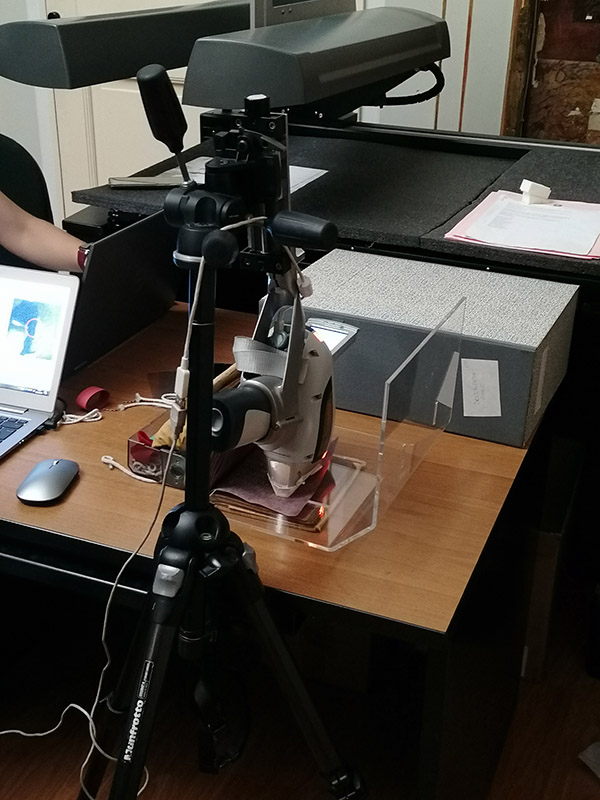
In the present study, XRF (X-ray fluorescence) analyses were carried out with a portable XL3T GOLDD spectrometer (East Greenbush, NY, USA from the UNI) from the Department of Chemistry of the University of Torino. The spectrometer is equipped with an Ag target with a maximum current of 100 μA and voltages between 8 and 50 kV (Fig. 8). The detector is a Large Drift Detector (LDD) with a surface area of 25 mm2 and energy resolution of 135 eV @MnKα. The geometry used is 30°/30°, with a working distance of 2 mm on the normal to the detector/source plane
Two acquisition modes were adopted: METALS and MINING, both with measurement times of 120 seconds. Each analysis involved 4 sequential measurements with 4 different voltages (main Al/Fe, 40 kV; low Cu, 20 kV; high Mo, 50 kV; light no filter, 8 kV) and 3 different filters in order to improve the material response in the energy range of the spectrum. The analysis was carried out on an ellipsoidal area with a maximum diameter of 3 or 8 mm which was controlled by a CCD camera. The data obtained were compared with the acquisition of a background at the same live time and with calibration standards (NIST, SGT, CORNING, MBH).
All the measurements were performed 3 times and averaged over the final value. All the acquired spectra were processed with the commercial software BAxil (Brightspec NV/SA, Belgium), derived from the academic software QXAS (IAEA).
 |
|
|
Portable XRF set up at Biblioteca Nazionale Vittorio Emanuele III of Naples. |
|
References
- Aceto, M., Agostino, A., Boccaleri, E., Crivello, F. and Garlanda, A.C., 2006. Evidence for the degradation of an alloy pigment on an ancient Italian manuscript. Journal of Raman Spectroscopy, 37(10), pp.1160-1170.
- Aceto, M., Agostino, A., Boccaleri, E. and Garlanda, A.C., 2008. The Vercelli Gospels laid open: an investigation into the inks used to write the oldest Gospels in Latin. X‐Ray Spectrometry, 37(4), pp.286-292.
- Aceto, M., Agostino, A., Fenoglio, G., Baraldi, P., Zannini, P., Hofmann, C. and Gamillscheg, E., 2012. First analytical evidences of precious colourants on Mediterranean illuminated manuscripts. Spectrochimica Acta Part A: Molecular and Biomolecular Spectroscopy, 95, pp.235-245.
- Aceto, M., Agostino, A., Fenoglio, G., Capra, V., Demaria, E. and Cancian, P., 2017. Characterisation of the different hands in the composition of a 14th century breviary by means of portable XRF analysis and complementary techniques. X‐Ray Spectrometry, 46(4), pp.259-270.